By Mary C. Chervenak, Yuk Mun Li, Daniel Stark, Jeffrey Arendt, and Jennifer Hall, Arkema
Wood, by virtue of being a renewable material, and when sourced from responsibly managed forests, constitutes a sustainable and responsible building material. If continuously exposed to water, wind, and sunlight, though, wood substrates are subject to damage, manifested as discoloration, cracking, and decay. Protective coatings can delay or prevent damage, improving the durability and prolonging the life of this vital natural resource. There is a demand for wood coatings with low-volatile organic compound (VOC) content, a requirement often achieved with “VOC exempt” solvents.
Recognizing that the use of certain, widely used VOC exempt solvents may be permanently restricted in many applications because of proposed state-level environmental regulations—for example, by the South Coast Air Quality Management District in California as early as 2026— creative solutions to match VOC and performance targets are critical. A proprietary polymer has been developed that enables the replacement of these VOC exempt solvents with water. Using this unique technology, a low-VOC waterborne coating for exterior wood substrates has been formulated to provide exceptional protection, which meets or exceeds that of conventional wood coatings.
Introduction
As an exterior substrate, wood has both practical and aesthetic advantages. Not only does wood offer an organic, warm look, it readily accepts color, ranging from semi-transparent stains to fully opaque coatings. Notably, wood can act as a natural insulator. Wood substrates, therefore, are an attractive and environmentally sound alternative to brick, concrete and vinyl.
Wood substrates, however, can be an expensive option, because regular maintenance is required to prevent decay, damage from insects, and deterioration caused by weather. Wood is particularly susceptible to fluctuations in environmental moisture. Continuous high humidity and periodic severe and wet weather can result in warping, cracking, and rot, which, if not addressed by timely repairs, can lead to irreversible structural damage.1,2
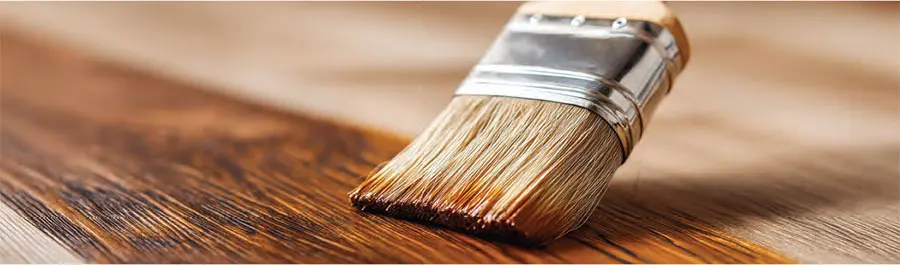
Protective coatings are therefore critical to maintaining exterior wood substrates. One such coating, spar varnish, is particularly effective. Spar varnish, also known as “marine varnish” or “yacht varnish,” was originally developed for use on the wooden poles that support the sails (“spars”) of sailing ships.3 Generally, a spar varnish is composed of an oil, like tung oil or linseed oil, which penetrates the substrate, and a resin, such as an alkyd or a polyurethane, which provides hardness. These components are solubilized in a compatible solvent, which contributes to ease of application. Spar varnishes are formulated to be flexible, allowing the coating to expand and contract in concert with changes occurring within the wood substrate, and water resistant, allowing the coating to provide a barrier to environmental moisture. Spar varnishes are also typically formulated with UV-absorbing compounds, which both extend the lifetime of the coating and prevent the substrate underneath from degrading.
As of 2023, the global market size for marine spar varnish was valued at approximately USD 1.2 billion. This market is projected to reach around USD 2.5 billion by 2032, growing at a compound annual growth rate (CAGR) of 7.5%.4 This growth is the result of increasing demand for protective coatings in marine applications and outdoor wood furniture, as well as increased awareness about the importance of safeguarding wooden structures against harsh environmental conditions.
Solvents typically used to formulate a spar varnish include mineral spirits, aliphatic hydrocarbon-based solvents, such as naphtha, and aromatic solvents, such as xylene. While the volatile organic compound (VOC) content can vary, VOC content for a standard spar varnish using traditional solvents usually ranges close to 475 g/L. The VOC limit for spar varnishes under the South Coast Air Quality Management District (SCAQMD) in California and the Ozone Transport Commission (OTC; Mid-Atlantic and Northeast) Model Rule 2010, however, is 275 g/L.5,6 For a spar varnish to meet lower VOC requirements, “VOC exempt” solvents, such as parachlorobenzotrifluoride (PCBTF) or tert-butyl acetate (t-BAc), must be incorporated.
The U.S. Environmental Protection Agency (EPA) granted PCBTF and t-BAc exempt status because these solvents have negligible photochemical reactivity and do not significantly contribute to ground-level ozone formation.7,8 PCBTF is the most widely used VOC exempt solvent in the coatings and adhesives industry. Another VOC exempt solvent, tert-butyl acetate, has been promoted as a potential replacement for the halogenated PCBTF. In 2022, however, the SCAQMD included a provision in Rule 1168 (Industrial Adhesives and Sealants) that prohibited the use of PCBTF and t-BAc.9,10 The District intends to follow through with identical rulings for other coating rules, including Rule 1136 (Wood Products Coatings) as early as 2026.11 Recognizing that the use of VOC exempt solvents may be permanently restricted in many applications, creative solutions to match VOC and performance targets are needed.
Continue reading in the January-February issue of CoatingsTech