

By , GAF|Siplast Building & Roofing Science
The construction industry is experiencing a paradigm shift from focusing solely on sustainability to embracing comprehensive resilient design, driven by increasingly severe weather events and rising financial risk. While sustainable design emphasizes minimizing environmental impact and resource conservation, resilience—the capacity to adapt and maintain functionality after a disturbance—demands a systems-based approach that addresses future-looking hazards like high winds, hail, fire, and flooding. This article argues that true durability requires building materials, including advanced coatings, to work collaboratively as integrated systems to resist extreme loads that exceed minimum building code requirements. It explores current design resources like LEED v5 and FM Global standards, and provides specific examples of how materials are engineered to resist hazards. These examples include multilayer roofing systems designed for very severe hail, and innovative coatings and membranes used in water-retention assemblies to manage urban storm runoff. Ultimately, resiliency is redefining what it means to create durable, lasting buildings, positioning systems-level thinking—rather than isolated product properties—as the foundation for a future-proof built environment.
Introduction
Resilient design has become a catchphrase within the construction and architecture communities. Over the last two decades, forward-thinking designers and building owners have focused not just on the now, but on the future, when determining their designs. This challenge started with a focus on sustainability. The U.S. Green Building Council (USGBC) defines sustainable design as “creating places that are environmentally responsible, healthful, just, equitable, and profitable.”1 Sustainable solutions often refer to minimizing the burden on the natural environment, recycling, and conserving energy and other natural resources. These goals have created a multitude of industry buzzwords, including durability, recycled content, energy efficiency, and carbon neutral. However, sustainability is not the same as resiliency.
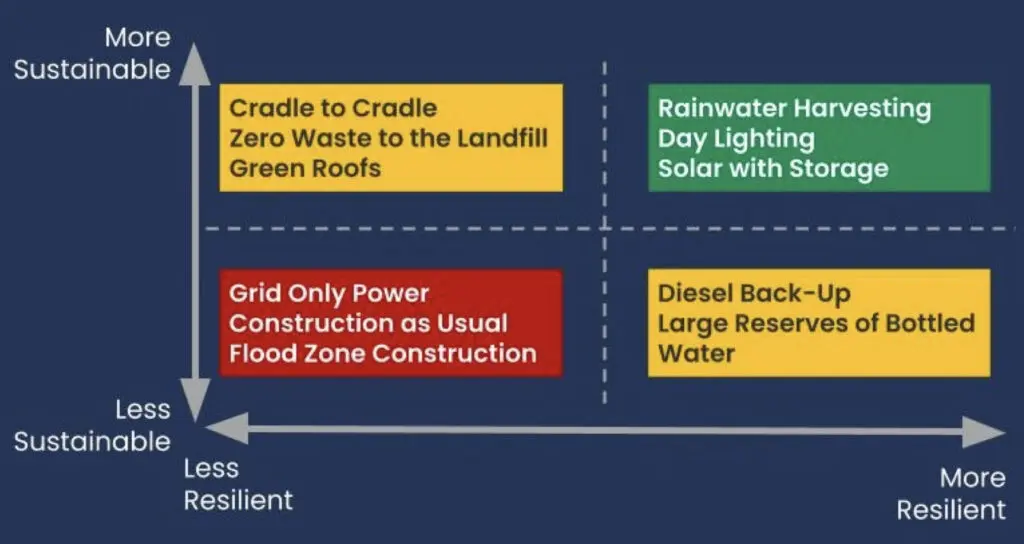
Resilience is defined by the Resilient Design Institute as “the capacity to adapt to changing conditions and to maintain or regain functionality in the face of stress or disturbance. Resilient design solutions often consider durability as well as the ability to keep a building functional after a weather event.”2 Solutions such as having a generator to maintain power are very resilient, though not necessarily sustainable (Figure 1). To be truly resilient, designers and building product manufacturers must look at more than product properties such as Volatile Organic Compounds (VOC) and embodied carbon, often the go-to for sustainable design, and more at materials working together as systems. There is no one property that ensures resilience. Designers and manufacturers need to collaborate to create complete systems of materials that work together to achieve a successful outcome. The ultimate goal is for designed solutions to meet both sustainability and resiliency targets, such as slowing the release of storm water to prevent overloaded sewers while also using some of the captured rainwater for irrigation.
One example of resilient design is the Sand Palace, which was one of the only structures left standing in its area after Hurricane Michael in 2018. Built specifically to withstand severe storms, the house utilized advanced materials like insulated concrete forms (ICFs) and was designed to resist winds of up to 250 mph, significantly exceeding state building codes at the time. The homeowner explained that they deliberately went “above and beyond code” when making material and design decisions by consistently asking, “What would survive the big one?” It is estimated that the house cost 15-20% more as a result of these decisions. Although they did have to replace utilities and experienced the loss of the first floor along with one of the air handlers, the overall damage was minimal compared to the surrounding properties.
Resiliency has become an important design strategy for many reasons, but the primary driver is money. It is expensive to rebuild after severe weather events, and insurance companies are noticing. In some parts of the United States, it is becoming more expensive and more difficult to get insurance, particularly in coastal regions and areas prone to wildfire. For example, a 2024 report from the Senate Budget Committee shows that the nonrenewal rate in Florida increased 280% between 2018 and 2023.3 Additionally, FM Global, one of the largest insurers of commercial properties, continues to expand the areas where their buildings must meet very severe hail requirements.
On the residential side, prospective homebuyers are paying attention to the potential weather impacts on properties. In 2024, Zillow started posting hazard ratings for climate-related impacts such as flood, wildfire, wind, heat, and air quality on property listings.4 As with other trends within the construction industry, significant attention is paid when there are clear drivers to profits and losses. This article introduces published resources and references being used by designers to design for resilience. It then looks closely at specific examples in which coatings and other building materials work together as systems to withstand increased building loads.